Back to Blog
Ekincy4 min read
Template or custom build? An honest comparison for business owners
Short answer: If your needs are standard, a template platform (Shopify, Wix, a WordPress theme) is the right choice and custom development is wasted money. Custom becomes worthwhile when your business processes stop fitting inside what the platform allows — or when the platform's monthly bill starts to sting. The deciding factor isn't your budget. It's how standard your requirements are. This article compares the two on real cost, ownership, performance and growth — and says plainly which one fits which situation.
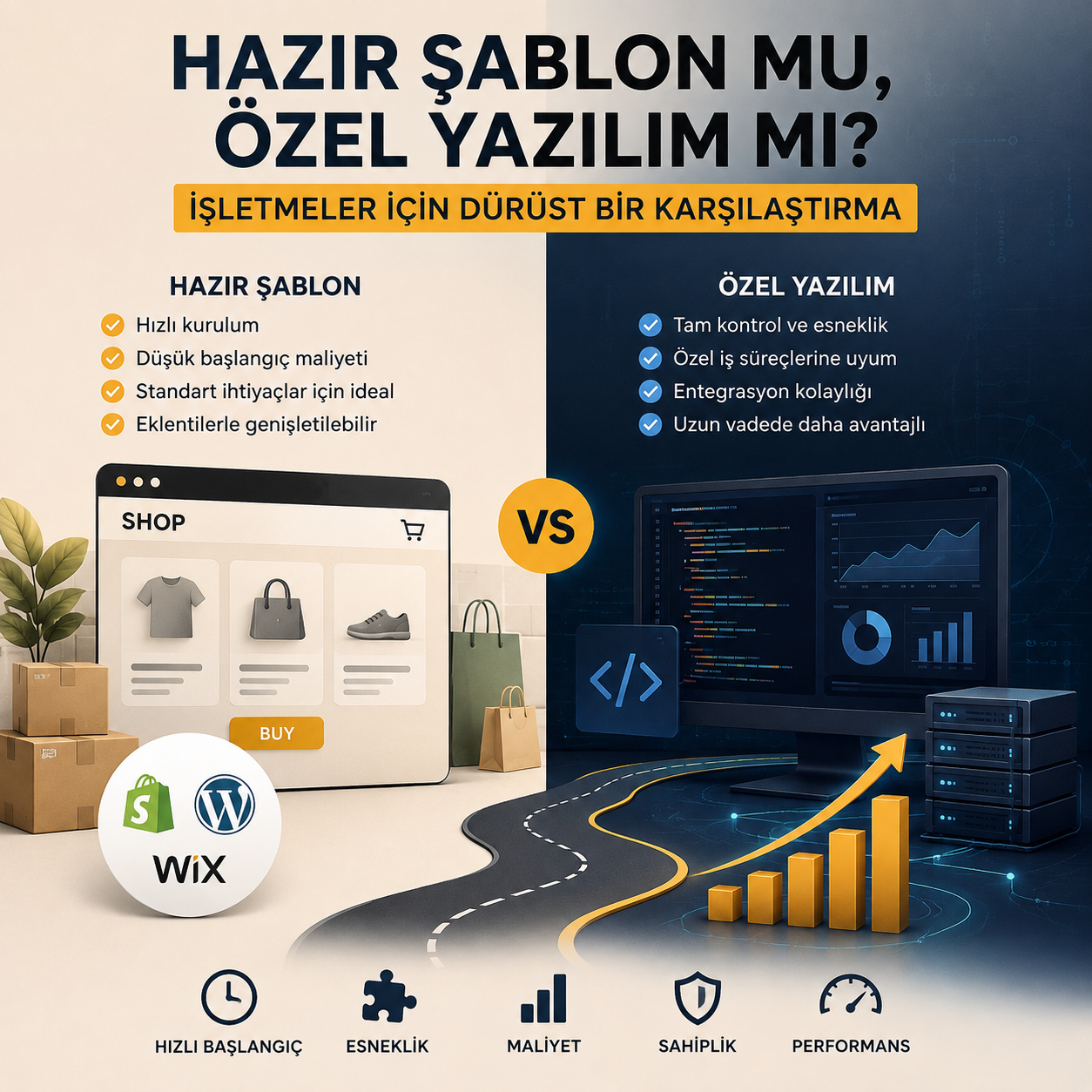
When is a template enough?
Use a template if most of these describe you:
What you sell is standard. Product, cart, checkout, shipping. No unusual ordering flow. Your catalogue is manageable and doesn't have to stay in sync with another system (ERP, accounting). You need to launch fast. You want to be selling within a week. You have no technical team and don't want to depend on someone for every change. You're still testing the idea. You don't yet know whether the demand is there.
That last point matters most. Commissioning custom software for an unvalidated business idea is like buying the building before you've opened the shop. Start with a template, see the demand, then decide.
To be direct: we tell some of the people who approach us that they don't need custom software yet and should start on Shopify. A client who comes back six months later with real data is a far better partner than one who made the wrong investment on day one.
When do you actually need a custom build?
If you're hitting any of these, you've reached the edge of what a template can do:
Your ordering flow isn't standard. In Turkey the most common example is cash on delivery and ordering over WhatsApp. A significant share of buyers won't enter card details before seeing the product; others prefer to order by message. A card-only checkout means losing part of your customer base at the door. Your app bill has crept up. On template platforms every extra capability is a paid add-on, billed monthly. For mid-sized stores app spend can run into the hundreds of dollars a month — which starts to look like the instalment on a one-time development investment. You need to talk to another system. Accounting software, warehouse management, supplier integrations, your own mobile app. The platform says no. No add-on solves it, no theme tweak gets you there. This is the clearest signal of all. Performance and SEO have stalled. Stacked add-ons slow a site down, and a slow site costs you both conversions and search rankings. How should you actually compare cost?
The most common mistake is comparing a template's monthly fee against a custom build's one-time price. The right comparison is total cost of ownership over three years.
On the template side, that total includes:
Platform subscription (on Shopify as of 2026, roughly $39/mo for Basic, $105/mo for Grow, $399/mo for Advanced) Premium theme (one-time) Add-on apps (monthly, and they accumulate) Transaction fees (a percentage of each sale, varying by plan) Whatever you pay someone to set it all up
On the custom side:
Development (one-time) Hosting (usually low, sometimes starting on a free tier) Maintenance and future work (optional, monthly or hourly)
Here's the part that decides it: a template's cost rises as you grow; a custom build's doesn't. Higher revenue means higher plan tiers and more commission paid. Your own infrastructure handles ten times the orders on the same server. At small scale a template is always cheaper. Past a certain volume the gap closes and then reverses.
What about SEO and speed?
Template platforms give you baseline SEO out of the box — meta tags, sitemap, mobile responsiveness — and that's genuinely enough. The problems start at the next level:
You have limited control over page speed; every add-on you load slows the site URL structure follows the platform's rules, not yours Structured data and technical details offer little flexibility Server-side rendering — which AI search engines need in order to read your content — isn't guaranteed on every platform
That last point is becoming decisive. People no longer ask only Google; they ask ChatGPT and Perplexity too, and most of these crawlers don't execute JavaScript — they read raw HTML. Control over how your content is served is going to be one of the deciding factors in this choice going forward.
Ownership: can you leave?
With a template, the site isn't yours. You rent it. That has concrete consequences:
If the platform raises prices, you have no alternative If it removes a feature, you adapt If you want to migrate, your data (products, orders, customers) can be exported — but your design and custom flows can't. Those get rebuilt from scratch.
With a custom build, the code is yours. You can change developers, move servers. It's a guarantee that looks irrelevant at small scale and grows more valuable as the business does.
When you sign a contract, ask one question: who owns the code? If the answer isn't "you," you're giving up the single biggest advantage of going custom.
Is there a middle path?
Yes — and for most businesses it's the smartest one:
Phased migration. Start on a template, then customise the critical piece once the business is established. Product management and checkout stay on the platform while the customer-facing storefront is built custom (the headless approach).
Hybrid ordering. Keep using the platform's payment infrastructure and add your own channels alongside it — a cash-on-delivery form, WhatsApp handoff with a pre-filled message, your own order tracking codes.
Fix only the bottleneck. Instead of rewriting the whole site, building just the one process that's actually holding you back — stock sync, quote flow, reporting — is usually enough, and far cheaper.
Five questions to decide
Ask yourself these. Three or more yeses means it's time to talk about a custom build:
Is there something central to my business that the platform simply can't do? Have my monthly add-on and commission costs approached the instalment cost of a development project? Do I need to exchange data with another system (accounting, warehouse, ERP)? Is my site slow in ways I can't fix? Have I validated this business model with real sales data?
If the answer to the fifth is no, stay on the template regardless of the others.
Summary
A template meets a standard need quickly and cheaply; if you're still testing the idea, it's the right call. A custom build becomes both cheaper and more sustainable once your needs stop being standard — an unusual ordering flow, system integrations, performance you can't control, or an add-on bill that keeps climbing.
The two aren't rivals. They're different stages of the same road. The only real mistake is picking the one that doesn't match the stage you're at.